NFTs became one of the most talked-about phenomena in finance and technology between 2021 and 2022. While the initial hype has subsided, NFTs continue to represent a significant concept in the evolution of digital ownership. This guide explains what NFTs are and what Indian investors should know.
What are NFTs?
NFT stands for Non-Fungible Token. To understand NFTs, you need to understand fungibility:
Fungible: Identical and interchangeable. One ₹100 note is identical to any other ₹100 note. One Bitcoin is identical to any other Bitcoin.
Non-fungible: Unique. A specific painting, a specific cricket match ticket — these cannot be swapped with another item of the same type because each one is distinct.
An NFT is a unique digital token on a blockchain that represents ownership of a specific digital (or sometimes physical) asset. Each NFT has a unique identifier that distinguishes it from all other tokens.
How Do NFTs Work?
NFTs are created (minted) on blockchains — most commonly Ethereum, Solana, or Polygon. When an NFT is minted:
- A smart contract creates a unique token with a specific ID
- That token is associated with a piece of content (image, video, music, etc.) or metadata
- The blockchain records who owns the token at any given time
- Ownership can be transferred through a sale
Importantly, owning an NFT usually means owning a blockchain record of ownership — not necessarily the underlying content file itself, which may still be hosted externally.
NFT Use Cases
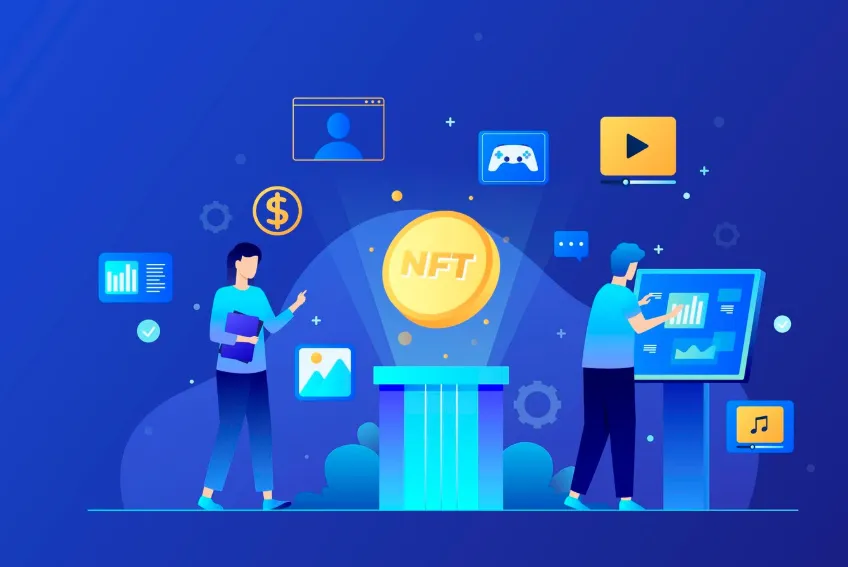
Digital art: Artists mint their work as NFTs, allowing collectors to own verified originals. This was the primary driver of the 2021 NFT boom.
Gaming: In-game items (weapons, skins, characters) as NFTs that players truly own and can trade outside the game.
Music: Musicians mint songs or albums as NFTs, allowing fans to own a piece of music with potential royalty rights.
Sports collectibles: Moments, cards, and memorabilia (NBA Top Shot, for example).
Domain names: Blockchain-based domain names (like .eth domains) as NFTs.
Real-world asset tokenisation: Representing ownership of physical assets (real estate, luxury goods) on-chain.
Ticketing: Event tickets as NFTs to prevent fraud and enable secondary market trading.
The NFT Market: 2021 vs. 2026
The NFT market experienced a massive boom in 2021:
- Blue-chip NFT projects (CryptoPunks, Bored Ape Yacht Club) reached prices of hundreds of thousands of dollars
- Daily NFT trading volumes reached hundreds of millions of dollars
- Many artists and creators earned life-changing sums
The market corrected significantly in 2022–2023:
- Floor prices of most NFT projects fell 90%+
- Many speculative projects became worthless
- Total NFT trading volume declined dramatically
In 2026, NFTs continue to exist but with a more measured market. Genuine utility (gaming, ticketing, real-world assets) drives more sustainable interest than pure speculation.
Can Indians Buy NFTs?
Yes. Indian residents can buy NFTs on NFT marketplaces like OpenSea, Magic Eden, and others using crypto wallets.
Tax rules for NFTs in India:
- NFTs are classified as VDAs under India’s Finance Act 2022
- Gains from NFT sales are taxable at 30%
- 1% TDS applies on qualifying NFT transactions
- No loss set-off against other income
- This applies even to NFTs with no monetary value if a transaction occurs
Consult a qualified tax professional for your specific situation.
Risks of NFT Investment
Illiquidity: Finding a buyer for a specific NFT can be very difficult, especially outside of top-tier collections.
Value based on speculation: Most NFTs have no intrinsic value — their price depends entirely on what someone else is willing to pay.
Wash trading: Historical NFT volume data has been significantly inflated by wash trading (buying and selling to oneself to create artificial price history).
Rug pulls: Many NFT projects promised utility that was never delivered. Developers disappeared after raising funds.
Copyright issues: Owning an NFT does not automatically grant copyright to the underlying content.
Market has corrected significantly: Many 2021 NFTs are worth a fraction of their peak prices in 2026.
Always conduct your own research before investing.
Frequently Asked Questions About NFTs in India
Are NFTs legal in India?
Yes. NFTs are classified as VDAs and are legal to own and trade, subject to Indian tax rules.
How do I buy NFTs in India?
You need: (1) a crypto wallet (MetaMask, Phantom); (2) crypto for the relevant chain (ETH for Ethereum NFTs, SOL for Solana NFTs); (3) an account on an NFT marketplace. Buy crypto on ZebPay, transfer to your wallet, then connect to a marketplace.
What happened to NFT prices?
Most NFT collections fell 90%+ from their 2021–2022 peaks. Speculative demand collapsed. Some blue-chip projects retain value; most do not.
Can I create my own NFT?
Yes. Any creator can mint NFTs on most blockchain platforms, though this typically requires paying gas fees.
Is NFT a good investment in 2026?
NFTs as pure financial investments carry very high risk. Genuine utility (gaming, verified ticketing) provides a more rational basis for value.
Final Thoughts
NFTs represent a real technological concept — verifiable digital ownership on a blockchain. The speculative frenzy of 2021 has passed, but the underlying utility of NFTs in gaming, digital art, and real-world asset tokenisation continues to develop.
Approach NFT investment with the same discipline and risk awareness you would apply to any highly speculative asset.
Get started today and join 6 million+ registered users exploring crypto investing on ZebPay!
Disclaimer: Crypto products and NFTs are unregulated and can be highly risky. There may be no regulatory recourse for any loss from such transactions. Each investor must do his/her own research or seek independent advice if necessary before initiating any transactions in crypto products and NFTs. The information in this article is for educational purposes only and does not constitute financial or investment advice.
