
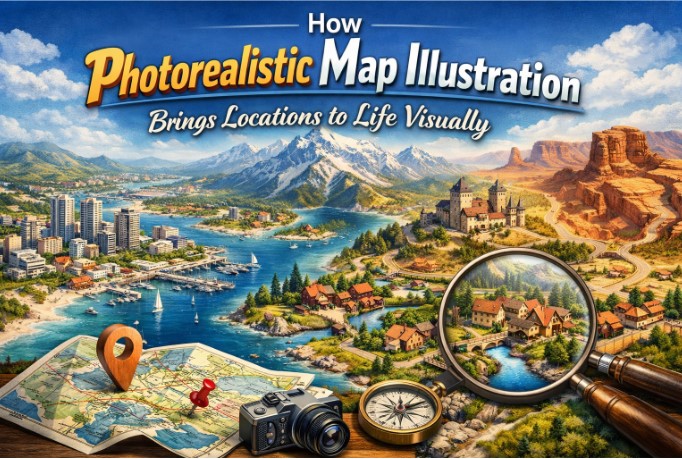
Sites are more than coordinates or neat shapes; they are inhabited, energetic places with palpable heat, visual relationships, interactive presence, neighbors, and measurable scope.
Flat maps often fail to demonstrate these dimensions and may alienate those lacking technical knowledge. Photorealistic mapping adds rich, tangible detail and drawing accuracy to this information so that the viewer gains a feeling of life and local reliability.
Overcoming the Limits of Flat Map Representation
While basic 2D mapping imparts readily quantifiable information, it lacks the ability to show the intangible atmosphere of a location. Photorealistic map illustration incorporate sunlight, shadow, textured surface materials, and regionally accurate settings. These visual features help site viewers, investors, and designers better conceptually and visually absorb space.
Debossed roads, realistic topography, proportional landmarks, and landscaped vegetation jump from the paper or screen to offer viewers contextual cues while displaying factual precision.
Depicting Accurate Spatial and Geographic Relationships
Other methods of spatial representation convey well the size and placement of features, but not the shape and relationships. Photorealistic imagery visually correlates two and three dimensions so that viewers see distances, proportions, and real-world scale.
A location takes on weight, meaning, and discernible mass that is essential for efficient planning, coordination, and foresight.
Positioning Real World Data in Meaningful Visual Contexts
Photorealistic maps outperform any other graphic tool in illustrating the overall setting of a place. Map layers include water features, land and tree cover, human activity, transportation routes, density, and land parcels.
Site viewers can see how the subject location operates as part of the larger environment. Strategic visual context elicits positive associations, clarifies preferences, and influences decisions.
Facilitating Location Geographical Awareness In and Around a Site
Conventional maps tend to exaggerate or minimize distances in order to fit all the necessary data on a page or screen. Photorealistic mapping unites a spatial perspective with a consistent sense of scale in relation to the viewer.
Users are able to compare areas, judge distances, and predict results with greater accuracy and efficiency. Ability to envision a site benefits construction timelines and staff utilization.
Cultivating an Inviting and Aspirational Emotional Reaction
Maps aren‘t bits of informational content; they are also presentation and persuasion paraphernalia. Photorealistic illustrations draw a positive emotional response by visually transporting viewers to an inspiring, real place.
City scenes, object views, and site plans that look as they could will increase viewers’ investment, curiosity, and excitement.
Accessible to All Non-Technical Audience Members
Without technical GIS knowledge or CAD software, some target audiences are unable to interpret traditional maps. Photorealistic site illustration communicates information visually so that they can understand.
Eye-catching imagery, easy-to-understand icons, and perspective provide complex data effortlessly. Projects reach a broader population by simplifying graphic details.
Adding Value to the Built Environment and Design Development
Rendering project details is even more compelling with expanded geographical detail. Photorealistic architecture illustration in conjunction with mapping programs tells a complete visual narrative.
Design and physical context are explicitly linked, so clients, investors, and planners are immersed in the designer‘s world.
Works Across all Media and Uses
Applicable for web pages, brochure mounts, digital signs, presentation boards, flash animations, glossy magazines, and billboards, 3D photorealistic map displays are highly adaptable in form. Their creativity adds gloss to any presentation.
Animations, screen-by-screen slideshows, and fly-throughs build an evocative virtual proposal. The immersive feel invites interaction.
Making Well-Informed, Sound Decisions
Clear pictures of space and dimensions inspire confident action. Investor groups, tenants, transit agencies, and customer groups are armed with the comprehensible visuals needed to make improved commitments.
What you see is what you get. Sensible visuals foster sound plans.
Conclusion
Locations become familiar places when visualized through realistic, photorealistic images. Human perspective, textural imagery, and natural surroundings energize the map while explaining a location‘s utility. By escaping the constraints of flat CAD forms and shifting into integrated, rich visualizations, viewers find it even easier to understand key spatial concepts. Tell clients, stakeholders, and prospects exactly what to expect with captivating, naturalistic, photorealistic maps.
