
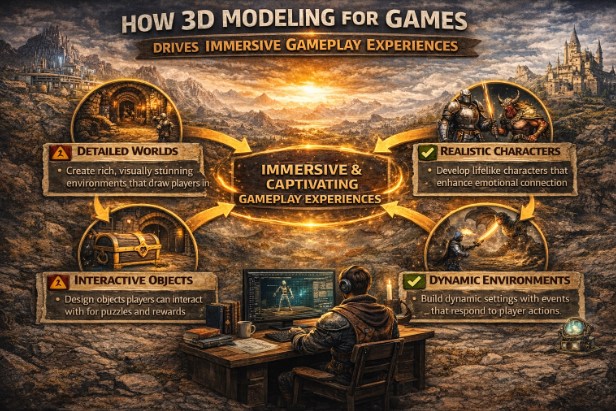
One of the most substantial aspects of game development in the modern day involves immersion. The players want to feel immersed in the game world, emotionally connected with the characters, and utterly engrossed with their surroundings.
And at the very heart of this visual foundation lies 3D modeling for games, transforming abstract ideas into tangible worlds players can explore, interact with, and believe in.
Immersion Begins with Believable Worlds
Coherence of the game world is essential in an immersive game. The environment needs to present itself as a world made up of thought and consideration, not merely assembled in an utterly arbitrary manner. Modeling will define the physical logic of these spaces: how the buildings are shaped, how the terrain flows, and how objects relate to one another.
Well-modelled environments help to:
- Give a sense of place and scale.
- Don’t force it-make the exploration organic.
- Support environmental storytelling without dialogue.
Character Presence and Emotional Engagement
Characters are often the emotional anchors to games. Whether controlled by a player, encountered as allies, or enemies, characters must feel alive and responsive.
Strong character modeling creates a sense of immersion in the following ways:
- Supporting Expressive Animation
- Maintain believable proportions and postures.
- Allowing subtle movement that feels natural.
Poorly modeled characters, even with good textures, will seem stiff or even artificial. And once the movement does not look natural, immersion breaks pretty fast.
Visual Consistency and Player Trust
Immersion relies deeply on trust. The players need to trust in the world’s existence, its rules, and visual coherence. Inconsistent scale, mismatched proportions, or sudden shifts in visual quality pull players out of the experience.
Consistent modeling helps:
- Reinforce the game’s art direction.
- Maintain Visual Continuity across Levels.
- Avoid immersion-breaking distractions.
Even very stylized games require internal consistency to be immersive.
Visual Readability to Support Gameplay
Modeling supports game-play clarity through:
- Defining clear silhouettes for characters and objects
- Avoid unnecessary visual clutter.
- Maintain readable shapes during movement and combat.
With core production, this pipeline of 3D modeling for games directly helps assure that players can focus on decisions and reactions rather than struggling to interpret the scene.
Wordless Environmental Storytelling
The most powerful forms of immersion come from environmental storytelling. Rather than explaining everything through exposition, be it spoken dialogue or even text-games, more often than not, leave it to the players’ imaginations to fill in stories through visual cues.
Effective modeling enables storytelling by:
- Showing wear, damage, or decay of structures
- Reflecting culture and history through architecture.
Suggesting Past Events by Using Object Placement
These little touches make the world feel lived in and impactful, inviting players to dig deeper.
Interaction and Physical Believability
Immersive gameplay requires physically grounded interaction. Doors open naturally, objects feel substantial, and spaces react logically to player action.
Modeling influences interaction by:
- Defining Precise Collision Boundaries
- Supporting believable object scale and weight
- Ensuring animations align with the physical structure
Immersion strengthens when interactions behave as players expect; when they don’t, immersion breaks instantly.
Real-time Performance and Stability of Immersion
Even the most impressive-looking game loses immersion when performance is an issue. Every dropped frame, stutter, or lagged input reminds the player regularly that they are just interacting with software and not a world.
Performance-aware modeling helps:
- Ensure stable frame rates
- Minimizing visual pop-ins and loading delays
- Supporting smooth animation playback
Stable performance allows the players to invest emotionally and mentally in the very gameplay, rather than be distracted by possible problems.
Camera Perspective and Spatial Awareness
Different camera perspectives-first-person, third-person, and isometric- place unique demands on modeling. Assets must hold up from expected viewing angles and distances.
Good modeling ensures:
- Assets appear believable from the intended camera view.
- Important details remain visible when needed.
- Spatial relationships can be easily understood.
This clarity enables players to confidently navigate environments, further solidifying immersion.
Audio-visual Synergy
Immersion is enhanced when visuals and audio reinforce one another. Sound design is separate from modelling, but the two go hand in glove.
Modeling facilitates audio immersion by:
- Defining surfaces that match sound behavior
- Supporting believable interaction points
- Audio cue alignment for movement
It feels cohesive and real when the visuals and sound are synchronized.
The Role of External Expertise
With game worlds becoming ever more complex and extensive, many studios spread some of the work to external partners in order to meet production demands. Working with a professional 3D visualization company will enable scaling of asset creation while quality and technical standards remain consistent.
External expertise helps:
- Maintain immersion across large asset libraries
- Minimising inconsistencies during rapid production
- Support Specialized Modeling Needs
Third-party add-ons that are integrated well do not appear disjointed, but rather organic.
Immersion across genres of games.
Immersion differs with the genre: atmosphere and tension in horror games, clear visualizations and responsiveness in action games. A more indie or stylized title may want its mood more than realism.
Strong modeling accommodates the genre needs by:
- Supporting Emotional Tone
- Reinforcing game pacing
Matching Visuals to Player Expectations
Whatever the genre, immersion depends on deliberate design decisions rather than brute detail.
Immersive experiences keep players in a game world longer. Where the environments feel believable, and the interactions feel natural, is where players are most likely to explore, replay, and recommend the game.
Conclusion
Countless little details come together in service of immersion: from believable environments and expressive characters to stable performance and intuitive interaction, the art of 3D modeling for games forms a foundation upon which players may dive deep into virtual worlds.
